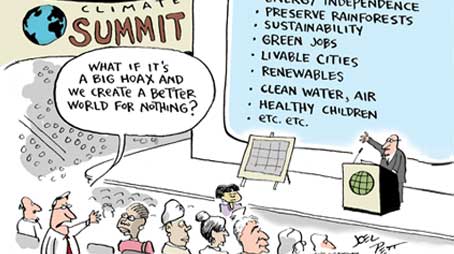
"Do you believe in God (however you choose to define that entity or those entities)?"
A dichotomous version of this question would allow only "Yes" or "No" as responses.
But doesn't this create a false dichotomy?
In particular, if I respond "No", someone might respond, "Ah, so you are an atheist, you believe there is no god". But that's not what I'm saying at all. I'm merely saying that I do not hold a belief in God. That is not the same as saying I hold a belief that there are no gods.
There is some ambiguity in the original version of the question"Do you believe in a god?"
One version is"Do you hold (or have) a belief in God?"To which I can legitimately respond, "Yes" or "No".
The other version is:"Does God exist?"To which a more nuanced response may be justified.
While we deify the concept of democracy, it appears to have lost much of its shine. The magic of democracy has diminished as a number of numbers show.
The declining faith in democracy is illustrated in the marked reductions in voter turnout observed over the last 50 years in Australia and elsewhere in the world. Political scientist Simon Tormey in a 2016 lecture at Parliament House reports that while voter turnout varies from vote to vote, the general tendency is that we are becoming "reluctant voters".
Two inconsistent views about life 1. My life is nothing and supremely unimportant 2. My life is a great and glorious event In short, life is nothing and nothing is great!
-------------------------------------------
So, paradox, doublethink, conundrum, or something else?
Paradox: a logical contradictory statement: 'this statement is false' Doublethink: "Holding contradictory beliefs in one's mind simultaneously, and accepting both of them": "War is Peace, Freedom is Slavery, Ignorance is Strength" 1984, George Orwell Conundrum: a riddle whose answer is or involves a pun or unexpected twist: "People say nothing is impossible, but I do nothing every day." Winnie the Pooh, A.A. Milne
Marketing is easy, but only if you really understand it.
And most people do not.
Most people think that marketing is powerful, that it can make people do things that they would not otherwise do.
We have a long history of being scared of such things - like hypnosis, subliminal messaging, hard sell salespeople, etc.
But just because we're scared of the bogeyman doesn't mean that he exists! Subliminal advertising was debunked decades ago - but many still believe it.
A raft of headlines reported on a fascinating finding that linked State of Origin matches to a spike in domestic violence.
For instance, the SBS report ran the headline "Study exposes 'clear' Origin link to DV" (where DV is domestic violence).
Big story because basically, the data showed that between 6pm on State of Origin night to 6am the following morning, domestic violence increased by 40%. Incidentally, non-domestic violence (blokes beating up other blokes) went up by 70% as well.
Despite this sobering result, the media have leapt on this story, and spun a long drinking yarn. Specifically, they have drawn conclusions about the involvement of alcohol in all of this - even though alcohol consumption is not directly observed in the original study in any way.
Ethics is the philosophy of action. So part of its domain surely therefore includes, the philosophy of inaction.
And this is a defence of doing nothing.
But there's so much to be done!
How can I defend inaction in a world with so many inequalities and injustices that plague our lives?
My answer? For precisely that reason! Precisely because so many are raging at inevitable inequalities and injustices which will forever plague our lives.
Blaming supermarkets for obesity is a little like chopping down a tree we are standing on. Or like tying our bootlaces together so we don't trip up on them.
Sure is eye-opening - if you have never been to a supermarket before.
Or eye-opening if you have been, but didn't notice the end-aisle displays because you were headed into the aisles which are filled to the brim with stuff that most nutritionist's would find to be equally awful.
No wonder we don't make any progress on obesity when we continue to run stories like this.
This kind of story about the evil of supermarkets is popular because it is an awesome cover story. It allows us to completely shift the responsibility to someone else.
Every parent has heard it: "He made me hit him."
Supermarkets, like siblings, are easy targets.
But supermarkets don't even make the products that people are so angry about. And if people are so damn angry, why are they still buying the stuff?
We're listening to the righteous leaders, while the masses (excuse the pun) are right behind waving their packet of chips and saying how they are right behind their nutritionist friends.
What about the good that supermarkets do?
Supermarkets have replaced the old family-run corner store groceries.
We've lost a way of life, rather like horses, carts and buggy whips. The wheel turns, and it does so because it generates something good.
Modern supermarkets give us access to an enormous range of food stuffs of excellent quality at a good price. Oh, and lots of choice!
And so many good things that supermarkets have done to support healhier life-styles. Supporting activities for local schools, introducing and supporting organic and other specialised food ranges, giving fruit away to the kids as they walk around the supermarket.
The reason why we don't talk about the good is simple. It ain't a story.
Are we serious about tackling obesity? If so, there is no "us" and "them." Sure supermarkets want to make a profit, and we want good food - meaning both good for you and just plain yummy even if not good for you - and we want it cheap.
We both individually and jointly contribute to the problem of obesity.
Time for us to make up our minds. Do we want to solve obesity?
Yes? Well then we need to make changes. And it's not about just one side or the other, but both sides together. Obesity is a community problem, one that consumers and marketers need to work on together.
Pointing fingers at the other side is like junk-food -- it has a really satisfying mouth-feel in the moment, but isn't doing us any good.
The Easter bunny is apparently a German innovation and brings painted eggs, candy and even presents to children who have been good.
What a delicious irony! A fiction to encourage honesty along with other good behaviour.
Meanwhile, neither parents nor clerics tell their respective flocks that there is no "bunny" in any of the stories about Jesus' death and resurrection.
We are not told that the word Easter commemorates a pagan goddess, Eostre. Or at least, might do if St Bede's account of Eostre is not a lie as at least some scholars contend!
What a web we weave, when we practice to deceive.
Does it matter if we lie? Well, how do I know when to believe?
The Bible (to stay with the Easter theme) would have us believe that Jesus was crucified on Friday and resurrected on Sunday.
Is it true or is it a lie? That's an awful lot of consequences if that is a lie!
But let's back up a little. Let's start by being a little clearer about what we mean by lying.
We like to believe that our beliefs come from good solid reasons. But given that we selectively choose evidence to reinforce what we already believe suggests otherwise (i.e., the confirmation bias). We only question our beliefs when evidence comes up to suggest it just ain't so.
Or so I like to believe... but maybe that simply ain't so!
Even in the face of overwhelming contrary evidence, the human mind remains remarkably resistant to doubt.
Consider Leon Festinger's fascinating work on a group who believed that the world would end on December 21, 1954. How would they deal with the evidence that their predictions of the date were wrong - assuming they were wrong?
Social media is to human connection what junk-food is to human nutrition.
Facebook like fast-food is convenient, it meets a desire, is superficially satisfying, it even offers some of what we need (connection or calories respectively), but by and large and in the long run, it is not all that good for us.
Look at the change in the fundamental unit of community — the family. Today, one in five children are raised in a home where the other biological parent is absent.
Some still see the nuclear family, mum dad and 2.5 kids, as the ideal. But the ideal community unit had already gone the way of REAL hamburgers and real food.
Prior to the nuclear ideal, the extended family lived together, providing a community that supported and sustained them all.
Even now, grandparents have time for kids that parents do not. But now the grandparents have their place and we have ours. We live our lives apart: each child in their own room, each parent may even have their own house. And the grandparents? Live elsewhere.
even though it's not good for me!
Mmm? I may be lovin’ it, but I am pretty sure it’s not good for me.
What is good for me? I’m not sure, but it seems more like when I live in a community, a village, surrounded by say 10–20 people whom I know and trust.
Facebook with 500 or more so-called “friends” cannot replace my village, the people I know and trust.
And trust should not be confused with like. All humans are flawed, and there may be things that I might not like about someone, but that does not mean I am not able to trust them. Trust means I know the person, I know her or his limitations, I know of the contexts in which I might trust them to do the right thing and which ones where they might not.
They are not even necessarily dear friends, I don’t even necessarily like them so much of the time. Rather, I know them, and can trust — as in rely — on them to behave in certain ways.
Uncle Frederic might be an odd-bird, a bit of a bore at social gatherings, still a bachelor and frankly, we can understand why. Nonetheless, he is good with the kids, and they love him, and at a pinch, he could be called in to take Cathy out for a talk and a soda as she wrestles with life as an adolescent.
Just as fast food has supplanted simple, real food cooked at home from scratch, so Facebook and the other online copy-cats have supplanted community created at heart in the home.
A “like” from some 500 or more of my Facebook “friends” may give me a little frisson of pleasure, but a more limited gesture of friendship is difficult to imagine. Pressing a thumbs-up symbol, and then moving on to the next image in a continuously changing stream of images and words is hardly much display of friendship let alone commitment.
The problem is that convenience is king in so many things. We love quick-fixes. And fast food and Facebook offer just that.
Unfortunately, what we want is not necessarily what we need. And what we need — healthy food, exercise, and making time and space for our village, some of whom are frankly a pain in the butt — is bloody hard work.
So we don’t bother. We choose the junk option, the quick-fix, the one that sets off the pleasure centre in our brain. We hear a ping on our phone and leap to look: someone likes me!
That’s not good, that is sad.
To feed your body, you need to eat well. To feed your soul, you need to connect well.
Some recent research from a sample of 957 members of PureProfile's Australian panel showed that people who classified themselves as "Early Birds" were two times more likely than "Night Owls" to earn over $70k per annum.
Specifically, 23% of Early Birds earned over $70k p.a. vs just 11% of Night Owls.
Does that mean that 23% of those who earn $70k+ are Early Birds and 11% are Night Owls?
Nope. If that were true, that leaves two-thirds (66%) of $70+k earners who are neither Early Birds nor Night Owls.
Does the result mean that there are more Early Birds than Night Owls earning above $70k per annum.
Not necessarily.
If the Night Owls are far more numerous than Early Birds in the total sample, then it is quite feasible for there to be more Night Owls who earn $70k+ even while Early Birds are two times more likely to earn $70k+ than Night Owls.
Making this error is very easy - unfortunately - and even downright confusing in some situations. Here's an example that can seem particularly confounding.
PureProfile's research showed that in the Australian population, men are more likely to be Early Birds than women. About 56% of men are Early Birds compared with just 45% of women (see yellow shading in table below).
However, when we turn the result around so it expresses the proportion of Early Birds (and Night Owls) who are male vs female, we may be surprised to see that 50% of Early Birds are women and 50% are men. (In actual fact, there are slightly more women who are Early Birds than men as we will see in a moment).
Whaaaaaaaaaaaaaat? How can that be?
The problem is one that often confronts us when we do crosstabulations. A crosstabulation (often shortened to crosstab) is simply breaking down the frequency of responses on one variable by groups (in this instance, the groups are male and female).
People tend to get confused because they see the first result (56% of males are Early Birds), and think that this is equivalent to saying that 56% of Early Birds are males.
But this simply ain't so.
Let's break this example out. First, here's the raw counts in each cell. In this sample, there are 945 males who are Early Birds - or 945 Early Birds who are male if you prefer. It is the same thing!
And note that there are slightly more women who are Early Birds than men: 951 women vs 945 men.
The proportion (or per cent) of males who are Early Birds depends on the total number of males there are in the column.
The proportion of Early Birds who are male depends on the total number of Early Birds there are in the row.
So, in a nutshell, there are 945 males who are Early Birds. This represents 56% of the total number of males (column %), but just a fraction under 50% of the total number of Early Birds (row %).
The key takeout is this. Whenever a percentage is being reported, take note of the base. Are you looking at the % of the column (in which case the sum of the column is 100%) or the % of the row (in which case the sum of the row is 100%).
Understanding this distinction is important - and surprisingly often misunderstood. Here's one extreme example to highlight the problem.
Nearly 100% of sexual assaults are perpetrated by males but that does not mean that all males (or even a high percentage of males) are molesters/rapists - thankfully.
However, that doesn't stop many parents, airline policies and even national news anchors from treating all men as potential molesters. Most molesters are male, but most men are not molesters. Again, thankfully.
Drawing this conclusion, and worse, enacting policy based on this result reflects a gross misunderstanding and misinterpretation of the statistics. And it happens to lead to inappropriate stereotyping of a lot of good men. If interested, you can read more about this case here.
How to minimise the danger of this error?
Whenever reporting a percentage, be very clear about what is the base, ie x% of what? Quite simply, % of men is not the same as % of Early Birds.
Meghan Trainor - it's all about the base!
If you're preparing crosstabulations (crosstabs), I generally recommend (and myself, generally present) column percentages only. That way, you know you're always comparing the % of column 1 to the % of column 2.
But what goes into the column and what goes into the row? Generally, we try and put the Causal factor into the Column, and the Result into the Row. As sex is generally decided many years before we begin to decide whether we like to get up early or stay up late, sex is the cause (put it into the column) which is thought to determine the result, namely, whether or not you are an Early Bird.
If you do want to swap it around (and see what proportion of Early Birds are female vs what proportion of Night Owls), swap the row and column variables and rerun your crosstabulation. That way, you are still reading column percentages. (It can still be confusing, but hopefully less so).
And practice. Swap the rows and columns, see if which makes most sense.
Above all, do not mistake the per cent of the column to be the same as the per cent of the row.
Not everyone is
lucky enough to journey into the "country for old
men" (and women). And even among those who are lucky enough to reach
old-age, not all learn as much from the journey as they might. Some arrive at
the destination having missed the journey.
Growing old is
inevitable, growing up is optional.
Is practical wisdom valuable?
Even in a
society which is increasingly technical and technological, there is some sense
that wisdom is a worthy goal, a knowledge worth attaining. Adapting the words
of Aristotle in Nichomacean Ethics only a little, we can see that his
observation applies still today:
"Although
the young may be experts in geometry and mathematics [and technology and
computers] and similar sorts of knowledge, they nonetheless lack practical
wisdom. Such wisdom is gained from experience which the young do not possess,
for experience is the fruit of years." (adapted from Nichomachean Ethics 1142a).
So even while we may rely on our children, our
grand-children or both to help us download apps to our mobile phone, to show us
how to connect our "smart" television to Netflix and how to stream
music through Spotify to our tablet and other devices, there is still a place for wisdom.
"The trouble with the world is that the stupid are cocksure and the intelligent are full of doubt." -- Bertrand Russell
Skepticism has received an increasingly bad name - but most of that is from mis-attribution.
Skepticism can be usefully distinguished from denialism - even though the word skepticism is used to describe anti-vaxxers to climate-change deniers,
In some instances, skepticism is used as a synonym of denial as in "I am skeptical about your claims", or "I doubt that what you say is true".
However, skepticism is more uniquely used to describe the notion of uncertainty - as in "I'm uncertain about the truth of what you say", or more simply, "I am uncertain about what is true".
The ABS is threatening two million households with fines if they do not complete their census at the same time as being "adamant the quality of data has not been compromised."
It's not so long ago that they reassured the public they would be able to cope with the demand on census night. They were wrong then - and they are wrong now.
The data quality has been hopelessly compromised. For one thing, at this point in time, there are two million out of "close to 10 million dwellings" that are yet to complete. That is, 20% who have not completed yet.
In the short run, #censusfail was about a data collection problem. The website for collecting the census data was inaccessible on the night of the census at the time that most people would have completed the census form. It remained inaccessible for a further 48 hours. Even longer for some.
The initial response to this colossal data collection glitch was a flurry of fingerpointing and promises that "heads will roll."
However, the bigger problem appears to have been totally overlooked. The real crux of #censusfail is less a data collection fail and more a data quality fail.
According to the magic mirror on the wall, Snow White was the fairest
by far.
But that's not fair! And so the beautiful but vain stepmother set about
fixing the problem.
We detest inequality in general, but we can easily confuse this with
the detest of those who have more than me. We
battle inequality, but we overlook what we have, and also what others have not.
That "Harry Potter girl" Emma Watson, charmed us
with her reminder of the dimensions of inequality that we fail to consider. And
the appearance afterward of trolls
and witch-hunts simply underlined her point.
In missing the inequalities, we miss the solutions too.
Annabel Crabb observes
that career women are frequently asked about how they manage their family
lives while men never are. Her solution is simple: "I don't think the
answer is to stop asking women. The answer is to start asking men."
Asking both working women and men about how they manage
their home life highlights that someone must manage it, hence the title of
Crabb's new book: The Wife Drought.
Unpaid domestic labour is not generally counted in measures
of economic activity but is estimated to be equivalent to up to half
of Gross Domestic Product.
Who does the work at home? Women do. At a rate
almost two times that of men and even greater if they have children. This
is true even in fairytales. The seven dwarfs agreed to protect Snow White in return for
unpaid household labour.
Men are generally expected to provide and do so, even at a
personal cost which often becomes apparent only at their deathbed. Working too
hard is one of the top
regrets of the dying says Bronnie Ware, and particularly among men.
Statistics
show that men have higher rates of pay than women with one notable
exception. The fairer sex makes a good deal more than men in fashion
modelling.
Statistics also show
that men have higher rates of being victims of violence, assault, work-related
injuries, suicide and earlier death.
As Sam
de Brito quips, "I'm surely not the only man who'd be happy to swap my
8 per cent for an extra five years of life, more time with my kid and the
guarantee I'll not be found swinging from a beam when I turn 55."
Just as a corporate women must explain how she manages her
home, stay-at-home fathers must explain why he is neglecting his career.
Fathers stepping up to help in the family are questioned, literally and
figuratively. We do not seem to like men being around children as reflected in
the following:
We don't even realise we're treating others unequally.
Consider the following scenario:
"Chris is a single parent of two and the director of
marketing for an electronics firm. Scheduled to present the key quarterly sales
report to the Board, Chris arrives 15 minutes late after dropping the children
at school and day care. In addition to dishevelled hair, there is a noticeable
stain on Chris’ suit, the result of the young girl vomiting at the end of her
car trip after a hurried breakfast."
Research shows that 95% of people think that Chris is a woman. But Chris'
gender was not stated. We often fail to see our own unequal treatment of
others.
Striving to reduce inequality is important, but equality is
a myth. Men and women are not born equal and even the most earnest efforts
cannot rectify all the inequalities as the Monty Python team explain to Loretta.
And some efforts to reduce inequality create more damage
than good. According to relationship expert John Gottman, when communication
is reduced to criticisms
and contempt, the relationship is in trouble.
The gender-war is not helpful. In tackling one inequality,
we may create another. In the original Snow White, the evil
stepmother is forced to put on burning hot boots at Snow White's wedding and
dance until she dies.
The moral of this tale is that equality is not even true in
fairy tales. Our goal is to reduce inequality, to exchange inequalities.
Ask both women and men, "How are you managing your home
life?" Encourage fathers to step up and mothers to let go.
Now just share your toys nicely, and we'll all live happily
ever after.
Uncertainty is a paradox. On one hand, it is a potent and powerful force that motivates research, a need to know. The gratifying result of research is evidence used to guide practice and policy. On the other hand, uncertainty always remains after research because of the inherent complexity and ambiguity of the real world. So policy-makers and practitioners are (or ought to be) troubled about inevitable residual doubt. Examples include what to do about climate change, what body mass index is ideal and whether to test for prostate cancer.
Why uncertainty remains
Research may help reduce uncertainty, but it can never provide certainty. Research is an errorful process that peers into an obscure reality.
The appeal of owning a home seems deeply embedded in the psyche of Australians. Yet psychologically, it is not clear the home ownership dream is entirely rational. Achieving the dream may not be all we might have hoped, and chasing it may even do damage.
The psychological reason Australians want to own their own home is perhaps best expressed by Darryl Kerrigan in the uniquely Australian film, The Castle. It continues to be celebrated globally for showing that the house is just a shell that holds heart. To own your own home has a strong sentimental value, as Darryl says: “You can’t buy what I’ve got.”
Most people view obesity as an unequivocal bad -- both for the person and the public. But obesity is a wicked problem. That is, the obesity problem is ill-defined, characterized by complex and contradictory evidence, and unresolved due to conflicting judgments of what is "good" or "bad". Just one example of how the problem has been oversimplified is in identifying "big food" as the enemy, just like big tobacco before.
Marketers of food are soundly critiqued for creating large, super-sized portions. However, in a nod to the wicked nature of the problem, marketers are also critiqued for offering smaller portions. And rather more ironically, marketers are also criticised for promoting slim, "overly-idealised" body-forms.
The media, public health and popular views all share the view that obesity is a problem, but the real nature of the problem is more complex than many seem to realise.
Is there a middle ground in the debate on vaccines?
The debate about whether to apply more coercive pressure to
vaccinate such as the ['no
jab no pay' policy] is being clouded by polarised polemic.
Each side
appeals to a reasonably valid ethical claim: pro-vaccination to the public
good, anti-vaccination to individual rights. However, these ethical claims sometimes seem to serve vested self-interest rather than public interest. Moreover, that self-interest reflects an
over-estimation of the relative risks to health of vaccination and
non-vaccination respectively.
Guess the number of 'heads' out of 10 coin tosses, and you can keep this.
I think we tend to belabour the problem of statistical significance testing sometimes. The whole process is very intuitive.
Let me take you through a thought-experiment to show you this.
"I'm going to toss a coin 10 times. And to make it interesting, let me put this pineapple (Australian $50 note) on the table and make you this offer:
"If you guess the exact number of heads in the next ten coin tosses that I make, I will give you the $50. If you don't guess it exactly, I get to keep my $50. Are you willing?"
So assuming that you see that participating in this gamble is a "no-brainer", you say:
"Yes, sure."
So what number of coin tosses will be heads? Make your guess now.
Trompe l'oeil - making portions look bigger can help reduce consumption
Science has revealed a simple and incredible trick that will help you lose weight. No fooling! Or rather, by fooling your eye, you may get the desired result.
The trick is to make portions appear bigger than they are. This leads people to serve and eat less.
There are two ways that we come to have knowledge. One is by reasoning from repeated observations (inductive), the other is by ensuring the conclusion follows validly from the premises (deductive).
The two are inextricably linked. Each makes an argument that helps advance our knowledge of the world.
More surprisingly, each argument fails by the standards of the other!
Inductive vs deductive reasoning
Inductive reasoning is about coming to a conclusion from specific instances (empirical data), deductive reasoning is about coming to a conclusion from premises (logical reasoning).
The biggest mistake in market research is to worry about being wrong. Ironically, research can learn this lesson from one if its great detractors, Steve Jobs. He who famously dismissed market research saying "People don’t know what they want until you show it to them".
He was right about customers' lack of self-insight, but wrong about the value of research. Businesses want blockbusters, to crack the big time, go viral, be trending (upwards). They want and count hits as Steve Jobs knew and proved.
Her statement is, as she admits, sexist. It most certainly is, but my major issue is that it is patently wrong and misleading.
It is said that we use only 10% of our brain, that 20% of statistics are made up, and the remaining 90% of the population aren’t any good at proportions.
In polite conversation, topics like sex, politics, and religion are widely regarded as off-limit. Today, public policy issues like climate change and public health (vaccinations, naturopathic medicines, fast food marketing, etc.) also provoke such polemic that useful debate is impeded.
It is not the topic that is the problem.
It is that positive, meaningful conversation on these topics descends all too quickly from a meaningful dialogue to dogmatism, from disagreement to disagreeableness.
How do you turn an intelligent conversation into a ideological battle? Allow participants to advance confidently held, but opposing beliefs while assiduously denying uncertainty.
We love looking for gender differences. And then code them as blue and pink.
Marketers do it in order to better target a specific segment. Humans do it because it is simpler to deal in stereotypes.
The problem is that gender differences are less clear than we are inclined to think. In fact, some 'differences' are completely artificial such as the dress and hair-styles of men and women. It's painted pink and blue, but may be there's no difference underneath.
Men have an outie, women have an innie. Fact.
Women are shorter than men. Sort of. It may be true on average, but it is not universally true.
Gender differences are typically a matter of degree with the distributions of men and women overlapping to a great extent. They are not categorical.
Where to draw the line? Statistics can help, but it is not perfect.
More importantly, generalising about gender differences based on statistically significant mean-differences oversimplifies the reality, and may support stereotypes that discourage or even oppose individual choices.
Seeing gender differences can blind us to individual variety and preferences.
We often like to 'blame' marketers for pushing people to buy stuff that they do not need. On the other hand, customers often demand, and go to great lengths to source stuff which does very little. Think of things like rhino horn, homeopathy, anti-aging cosmetics, and status-related items. These items often fail to meet the wants of the customer to a greater or lesser degree. But customers keep on demanding them. So does marketing succeed because of the marketing efforts or the customer desires? And if it fails, is it the marketer or the customer who is to blame? What do you think? Consider resveratrol, a naturally occurring molecule found in red wine. Here's my take on the interplay of marketers and customers in the marketing of resveratrol.



)