Showing posts with label uncertainty. Show all posts

23 January 2022

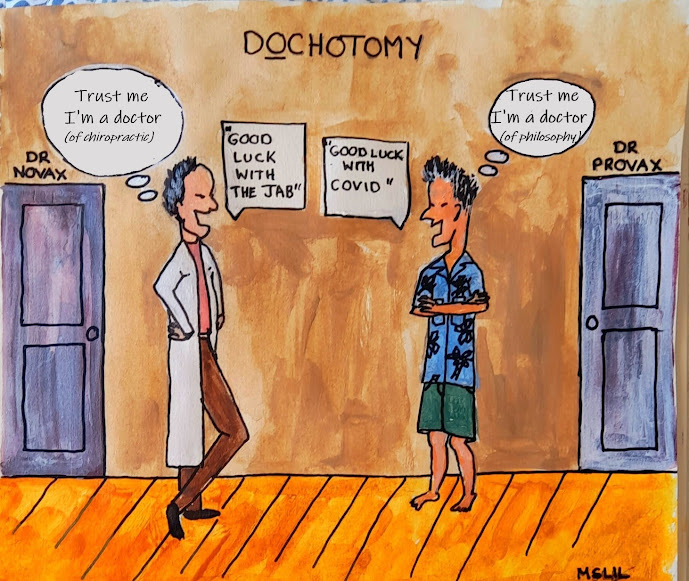
Doctors debating vaccination

Dochotomy by MsLil (2021)
 
 
(This article is a L-O-N-G read, and it is incomplete. Constructive comments are welcome.)


The ground rules for the debate

Dr Provax
: Greetings fellow doctor, what do you know?


Dr Novax: Afternoon doctor. What do I know? Not much. Well, not entirely true. There's one thing I know: I'm done with the continual coverage of COVID. It's been two years now.
 
Dr Provax: Agreed. And with the latest variant, and two years to prepare, it is time for nature to show the non-vaccinators the folly of their reasoning.

Dr Novax: Ah, so you're vaccinated?

Dr Provax: Absolutely. You're not?

Dr Novax: No.

Dr Provax: Oh my God, why not? You’re crazy. We need to stop you anti-vaxxers before you kill us.

Dr Novax: Whoa, whoa. We’re friends, so I’m happy to have this discussion, but only if we have ground rules.

Dr Provax: What ground rules?

Dr Novax: Let’s refrain from invoking any unproved metaphysical entities such as God who are unnecessary to the discussion here. No ad hominem -- meaning you can attack the argument, but not the person. Calling me 'crazy' is ad hominem. And try to wind back the hyperbole such as your presumption that I am an 'anti-vaxxer', and your exaggeration that non-vaccinators will kill everyone. Everyone? That seems a lot strong: for one thing, if the vaccine is protective, then the vaccinated ought not be especially threatened by the non-vaccinator’s choice.

19 January 2022

Predicting the future imperfectly


Do humans want to know their future?

Yes, people are interested in knowing their future.

We want to know the future in terms of…

  •  what the weather will be tomorrow, and the day after, and the day after…?
  • whether our new product is likely to be a success in the market or not?
  • whether our large investment will be go up or go down in value?
  • what numbers will win next week’s lottery? 
  • whether or not we will survive the fatal disease we have contracted (with certainty, not a probability)?
  • can modern medicine prevent or cure the fatal disease I have contracted?
  • can we humans live forever?
  • do humans avert their own extinction?
  • what is the human-experience after death (assuming our quest for human-generated eternal life fails)?

Can humans know their future?

The future remains uncertain. No matter how good our prediction skills, the future is uncertain, both empirically and logically.

Empirically, even if we have “big data”, massive computing capacity, and fantastic skills, the weather tomorrow may be as predicted, but it may not. There is no certainty about what the future holds, and complexity and chaos theory ensures that it remains so. 

Logically, even if the world is a series of causes and effects, there is no logic that permits us to say that many previous contingent events will occur again in the future (see Hume). Sure, the sun has ‘risen’ every day for thousands of millennia, but it does not logically follow that it will do so tomorrow. 

Even with “more data” and more skills, some of these questions about the future, especially the ones further down the list above, are likely to always remain beyond us. 

What is the human-experience after death? Who knows? It has not stopped many people developing stories of what they think, even believe, or perhaps wish will happen after death. But the truth is we do not know. And even more, that we are unlikely to ever know.

Do humans avert their own extinction? We might desperately wish it to be so, but humanity does or does not survive remains in the future, and is unlikely to be known. The problem is open-ended for even if humanity survives the current apocalyptic scenarios, the possibility of extinction in some other, currently unseen and perhaps unknown apocalyptic scenario remains.

Can we live forever? It hasn’t happened yet although it is clear that human life has been massively extended beyond the standard “three score years and ten”. Can a human live forever? Perhaps, but perhaps not. Even if we do manage to insert our mental selves into a machine, what happens if the world ends and the machine stops? 

So many unknowns. 

But there are also some confusions that get tangled with the idea of prediction.

The first is confusing possibility with prediction. It is possible that there is life after death, that humans escape extinction and that people get to live forever (or at least 200 years or more). So, yes, these outcomes might be possible, but that is not a prediction. The other outcome is also possible!

Which leads to the related issue of confusing guesses with predictions. Guessing that a tossed coin will come up heads is a guess, not a prediction. If the coin does come up heads, then it was a lucky guess, not a correct prediction.  

Predicting the future is already an uncertain game, but it seems certain that uncertainty will always plague questions about particular futures such as the human experience after death, whether humans avoid extinction, and whether humans can live forever. 

My prediction is that we will only ever be able to predict the future imperfectly.

- - - - - - - - - - - - - - - - - - -

"The history of predicting the future" (Rees 2021, Wired)
https://www.wired.com/story/history-predicting-future/

"Humans are bad at predicting futures that don't benefit them" (Beaton 2017, The Atlantic)
https://www.theatlantic.com/science/archive/2017/11/humans-are-bad-at-predicting-futures-that-dont-benefit-them/544709/
29 November 2021

Do you know what time it is ?

 
Claire asks Tiffany "Do know what time it is?"
 
Tiffany looks around at an old-fashioned clock sitting on the sideboard which shows that the time is 6.56. 

"Yeah, it is four minutes to 7," says Tiffany.
  
Following Tiffany's glance, Claire says, "Oh, that clock doesn't work. It always shows 6.56. So you are mistaken."
 
Tiffany looks at her mobile phone and says "Really? I think you are mistaken as my phone confirms that it is 6.56 at the moment."
 
(Adapted from Bertrand Russell, Human Knowledge: Its scope and limits, 1948)

QUESTIONS
 
Does Tiffany have a legitimate claim to "knowing" the time after viewing the stopped clock? 
 
If the time was 6.56, and Tiffany believed it was, and justified that belief by reading the clock, does she have knowledge? 
 
The notion that knowledge is 'justified, true belief' suggests that she does. Perhaps we ought to change the definition of knowledge? How would you change the definition?
 
ADDITIONAL SOURCES


31 October 2020

From impossible to improbable: small step or giant leap ?

Simon: Isn’t it ludicrous that some people think that the moon landings are a hoax? Bloody conspiracy-theorists! The moon landings happened, the evidence is incontrovertible.

Thomas: What is that evidence?

Simon: This article tells and shows how photographs taken by NASA's reconnaissance lunar orbiter reveal human footprints on the moon.

Thomas: Yeah, that seems compelling, but maybe the photographs could be fakes. Or maybe NASA actually landed a mechanical lunar rover on the moon that has two wheels on each side with boots in place of tyre treads, and it was set to "walk" around a bit. Voila! Footprints.

Simon: Aww, come on, that's just stupid.

Thomas: Stupid, yes. But possible, right?

Simon: No way. They have soil and rocks that they brought back from the moon that are not found anywhere on earth.

Thomas: Well, you’ve set up an interesting paradox: these rocks not found anywhere on earth are currently on the earth; they're found in NASA labs and museums. How can we be sure they are not elsewhere too? Absence of evidence is not evidence of absence. And besides, have you seen these rocks? Are you a geologist? Can you confirm that they absolutely cannot be of this earth?

Simon: No the experts have made this judgment. I trust the experts.

Thomas: Sure, I trust experts too. But I also know that it is sometimes wise to ask for a second opinion. Experts do not always get it right. Indeed, they often disagree: it's almost certain that for any expert opinion, you will be able to find another expert who has a different view.

Simon: Oh this is silly. The theory that the moon landings are a hoax is simply impossible.
 
Thomas: I'm not asking you to admit that there were no moon landings, or no humans walked on the moon, or even that they are a hoax. I'm asking you whether you might be wrong about man walking on the moon?

Simon: While I acknowledge the points you are making, let me respond with the 17th century idiom that your words 'doth butter no parsnips with me'. In the modern vernacular, I ain't buying it.

Thomas: Let me respond to your parsnips quote with another bizarre one from the same century called Cromwell's rule: 'I beseech you, in the bowels of Christ, think it possible that you may be mistaken?'  
 
Simon: What?
 
Thomas: Cromwell's rule says that anyone who is 100% adamant about their view is in trouble for two reasons: (a) they might be wrong and (b) they are blind to this possibility.
 
Simon: Ah, OK, I think I’m beginning to understand. You’re trying to crack me open to the idea that a hoax about the moon landings is possible. So let me respond using the words of an Aussie character Jasper Jones: 'Course it's possible. I don't reckon it's likely but'. And yes, I see that I can’t make the claim that the hoax is absolutely impossible.
 
Thomas: Yes, exactly. It's a small step, but with enormous implications.
 
Simon: But you have to make a giant leap to get over a problem that remains. Your view presents an absurdity, namely that the impossible is not possible at all! 😂 


Course it's possible. I don't reckon it's likely but.
 -- words spoken by Jasper Jones in Jasper Jones, Craig Silvey
 
Induction is the glory of Science, and the scandal of Philosophy
   -- C.D. Broad, Commemorative Address at The Bacon Tercentenary, (1926)

Words are but wind that do from men proceed;
None but Chamelions on bare Air can feed;
Great men large hopeful promises may utter;
But words did never Fish or Parsnips butter
   -- John Taylor, Epigrammes (1651)
 
I never made a mistake in my life.
I thought I did once,
but I was wrong.
  -- attributed to Charles M. Schulz, creator of Peanuts

29 June 2020

Practical uncertainty - believe less, be less certain

Entrance to Centre Court, Wimbledon
Believe less.
Be less certain.

Or rather, 
believe this one certainty:
there is always more to learn.

Learn well from your mistakes.

Your wins are nothing.
Self-aggrandizement from wins,
is a card-house
founded on luck.

Your losses are learning opportunities,
personal pain is the powerful teacher.
Lose that opportunity,
you lose everything!

Ask questions,
and pay attention.

Nurture conversations, dialogues, discussions, and even debates,
but aim for discovery rather than destination,
pursue exploration rather than exposition.

Better to question
than to answer.


13 December 2019

What is truth?

1. The Truth is... a riddle

What is something that humans seek, and don't know it when they see it?

The answer is the truth!

(C.f. Jacobellis v Ohio 1964 in which the judge declined to define hard-core pornography, but famously said "I know it when I see it".)

2. The Truth is... not known
 
The conundrum of seeking truth but not knowing it when we see it is embedded in the idea of knowledge as justified true belief

It is said that we know something to be true if 
    (a) we believe it to be true, 
    (b) we have justification for our belief, and 
    (c) it is true.

We can build towards knowledge 
with beliefs and justifications, 
but we fail unless it's true.

And how do we "know" if it's true? 
 
Whether something is true is... unknown. 

Frustrating! 

13 September 2015

Better to be uncertain than certain and wrong

Researchers cannot escape uncertainty

Uncertainty is a paradox. On one hand, it is a potent and powerful force that motivates research, a need to know. The gratifying result of research is evidence used to guide practice and policy.

On the other hand, uncertainty always remains after research because of the inherent complexity and ambiguity of the real world. So policy-makers and practitioners are (or ought to be) troubled about inevitable residual doubt. Examples include what to do about climate change, what body mass index is ideal and whether to test for prostate cancer.

Why uncertainty remains

Research may help reduce uncertainty, but it can never provide certainty. Research is an errorful process that peers into an obscure reality.

06 June 2015

Obesity, a wicked public health problem

Most people view obesity as an unequivocal bad -- both for the person and the public. But obesity is a wicked problem. That is, the obesity problem is ill-defined, characterized by complex and contradictory evidence, and unresolved due to conflicting judgments of what is "good" or "bad".

Just one example of how the problem has been oversimplified is in identifying "big food" as the enemy, just like big tobacco before. 


Marketers of food are soundly critiqued for creating large, super-sized portions.

However, in a nod to the wicked nature of the problem, marketers are also critiqued for offering smaller portions
And rather more ironically, marketers are also criticised for promoting slim,
"overly-idealised" body-forms


The media, public health and popular views all share the view that obesity is a problem, but the real nature of the problem is more complex than many seem to realise.